Is there balm in Gilead
The Raven“Is there balm in Gilead?” is the narrator’s most concentrated question about whether grief can be healed. Spoken after the Raven has entered the chamber and repeatedly answered “Nevermore,” the expression invokes a sacred source of medicine while exposing the narrator’s inability to find relief through books, self-reassurance, or supernatural hope. Its decisive significance lies in the collision between a language of promised healing and the Raven’s absolute refusal of consolation.
Context and Invocation
The question arises in a chamber already shaped by mourning. In bleak December, the narrator had wished for the morrow and sought unsuccessfully to borrow from books a surcease of sorrow for the lost Lenore. His unease intensifies as the rustling purple curtains fill him with “fantastic terrors,” leading him first to explain the disturbance as a visitor at the chamber door and then to steady his heart through repetition.
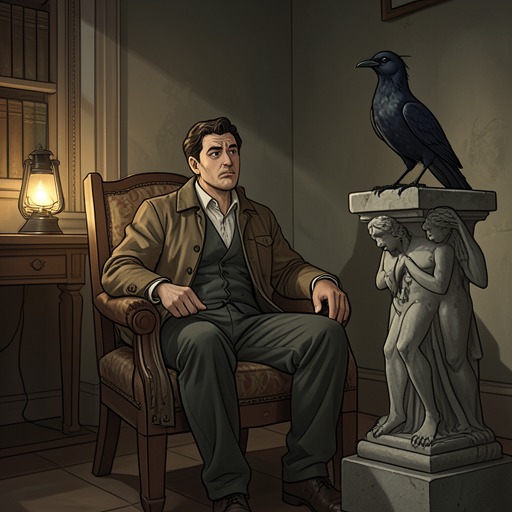
That effort at emotional control has already failed by the time the Raven appears. After the narrator opens the shutter, a stately Raven steps into the room and perches above the chamber door on a bust of Pallas. The bird’s grave decorum briefly beguiles the narrator’s sad fancy into smiling, but the encounter soon becomes an inquiry into meaning: the narrator marvels that the ungainly fowl can discourse plainly even though its answer seems to possess little relevance.
The Question’s Religious Pressure
The expression is spoken after the narrator imagines the air growing denser and becoming perfumed by an unseen censer swung by Seraphim. He interprets this imagined sacred atmosphere as a possible intervention, crying, “Wretch,” and suggesting that God has lent the Raven, through angels, to bring respite and nepenthe from memories of Lenore. The question about Balm of Gilead therefore follows a direct appeal to divine mercy and forgetfulness.
The biblical place-name gives the question a concrete spiritual and medicinal force. The narrator does not merely ask whether sorrow feels less painful; he asks whether a recognized balm exists in a world where healing might still be granted. Yet the surrounding language also shows that the desired cure is inseparable from memory: the proposed nepenthe would allow him to forget the lost Lenore, while the requested balm would answer the deeper wound that forgetting cannot simply erase.
Form of the Appeal
The wording is urgent and repetitive: “Is there—is there balm in Gilead?—tell me—tell me, I implore!” The doubled question and doubled command make the line a verbal act of desperation. The narrator is not conducting detached theological inquiry; he is pressing the Raven for an answer that might authorize hope. His address combines supplication with the language of interrogation, showing how emotional need turns knowledge into a demand.
The question also marks a change in the narrator’s treatment of the bird. He first calls it a stately Raven, then addresses it as a ghastly, grim, and ancient creature wandering from the Nightly shore. By the time he asks about Balm of Gilead, he calls it a prophet and a thing of evil, while still allowing that it might be a bird or devil, a tempter or a creature tossed ashore by tempest. The Raven’s status remains uncertain, but its answer is treated as authoritative enough to govern the narrator’s understanding of salvation.
The Answer and Its Consequences
The Raven answers the question with “Nevermore.” The single word supplies no explanation, qualification, or alternative remedy. It compresses an open spiritual possibility into an absolute negation, making the requested balm unavailable within the poem’s immediate world. Because the narrator has already heard the same answer to other questions, the response functions as repetition rather than fresh information, but each repetition deepens its emotional effect.
The denial does not end the narrator’s questioning. He immediately raises a further religious possibility, asking the prophet to tell the sorrow-laden soul whether, in distant Aidenn, it will clasp the sainted maiden whom the angels name Lenore. The movement from healing in the present world to reunion in the afterlife reveals the consequence of the Raven’s refusal: when earthly relief is denied, the narrator transfers his hope to eschatological reunion, only to confront the same “Nevermore.”
Narrative and Thematic Significance
“Is there balm in Gilead?” stands at the point where the narrator’s grief becomes explicitly theological. Earlier strategies—reading, explaining the knocking as ordinary, opening the door, and briefly smiling at the bird’s decorum—provide only temporary control. The question reaches beyond those strategies toward sacred medicine, angels, forgetfulness, and an afterlife, but the Raven’s fixed answer prevents any stable transition from mourning to consolation.
The expression’s force also depends on contrast. Gilead names the possibility of balm, while the chamber remains a home haunted by Horror; the imagined Seraphim suggest holy presence, while the Raven is associated with evil, prophecy, and the Nightly shore. At the poem’s close, the Raven is still sitting on the pallid bust of Pallas, its eyes resembling those of a dreaming demon, while its shadow lies on the floor and the narrator’s soul is caught within that shadow. The question therefore remains unresolved as a question but settled as an experience: whatever healing the narrator seeks, the Raven’s “Nevermore” leaves him without access to it.